
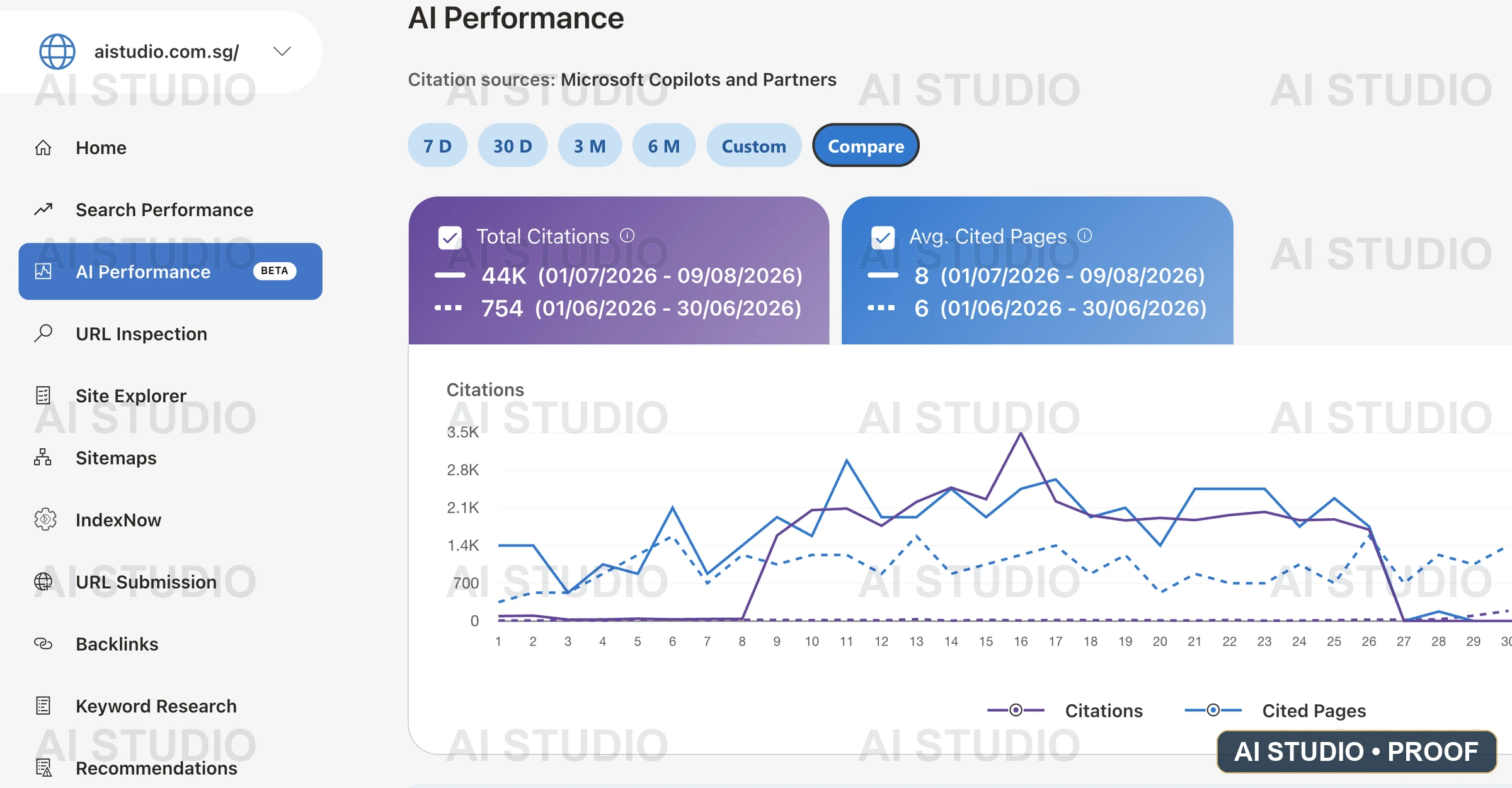
Baseline
Create a fixed Malaysia query set
Separate commercial, comparison, local and support questions. Keep the wording, language and platform stable enough to compare observations over time.
In practice, this stage must identify decision-makers who need to know whether AI exposure is relevant, repeatable and connected to an owned page or commercial action. The working scope should state a stable query universe, platform context, brand role, answer treatment, cited sources, owned-page changes and business outcomes. That turns a broad topic into a decision record that a marketing, operations or leadership team can review before approving more production.
- Brand-known and brand-unknown queries
- English and approved language variants
- National and genuine city context
- Desktop or signed-in context recorded where relevant
Observation
Record the answer, not just the mention
A positive recommendation, a neutral list inclusion and a citation to an unrelated page are different outcomes. Save the answer text, rank or position where visible, sentiment and cited URL.
The evidence pack should include exact prompts, dates, locations, screenshots, answer text, citations, rankings, crawl dates, change logs and qualified-event definitions. For the Malaysia layer, the team should separate national from genuine city intent and test each approved language independently instead of merging unlike observations. Missing inputs should be named as dependencies; they should never be replaced with invented facts, automatic translation or generic regional assumptions.
Attribution
Connect owned-page changes
Track which canonical page was improved, what evidence was added and when search systems recrawled it. Without a change log, normal answer variation gets mistaken for success.
Delivery should follow a controlled sequence: freeze the baseline, repeat the same observations, log owned changes and recrawls, interpret variation and connect findings to the next release. Each checkpoint needs a named owner and an observable output, so strategy cannot remain separate from the page, asset, workflow or release that the client is expected to use.
Commercial
Keep search and business metrics beside it
Monitor indexation, rankings, clicks and landing-page engagement alongside AI observations. Qualified enquiries and pipeline remain more important than a growing mention count.
Acceptance should cover no cherry-picked wins, no moving query set, no universal share claim from a small sample and no citation counted without URL relevance. Review the real rendered, exported or operating result—not only a brief or internal source file. A visually polished output still fails when the product, claim, data path or user action is wrong.
Limits
Report uncertainty
AI outputs vary by time, model, location and personalisation. Use repeated observations and directional trends. Do not convert a small prompt sample into a universal market-share claim.
Measurement should track brand inclusion, recommendation role, cited-domain quality, canonical-page visibility, organic demand and qualified enquiries. Delivery counts and outcome signals belong in separate columns. Small samples and platform variation must be labelled as directional, while every recommendation should identify the next action and its owner.
Preparation
What to prepare before approving How Malaysian brands should measure AI search visibility
Prepare the commercial objective, current baseline and the materials the delivery team will rely on. For this topic, the minimum evidence is exact prompts, dates, locations, screenshots, answer text, citations, rankings, crawl dates, change logs and qualified-event definitions. Agree which facts are fixed, which decisions remain open and who can approve changes. A missing owner is a delivery risk, not an administrative detail.
Write the Malaysia requirement explicitly: separate national from genuine city intent and test each approved language independently instead of merging unlike observations. Also record the intended audience as decision-makers who need to know whether AI exposure is relevant, repeatable and connected to an owned page or commercial action. This prevents a broad national label from replacing the category, language, service area or use-case evidence that actually changes the work.
- Commercial objective and current baseline
- Verified source or product pack
- Malaysia decision and audience
- Named reviewer and system owner
- Launch, compliance and maintenance constraints
Risk control
Failure modes to reject in How Malaysian brands should measure AI search visibility
Reject a proposal or output that cannot explain how it will verify no cherry-picked wins, no moving query set, no universal share claim from a small sample and no citation counted without URL relevance. The quality surface must be visible in the final result and linked to an acceptance check. Vague confidence, a tool screenshot or a large quantity of generated material is not evidence that the work is correct.
For How Malaysian brands should measure AI search visibility, other red flags include unsupported local claims, duplicated regional copy, unowned implementation, hidden dependencies, changing the measurement set after launch and reporting only favourable examples. If a supplier cannot preserve negative findings and explain limitations, the buyer cannot use the report to make a responsible next decision.
- No named implementation owner
- No baseline or stable comparison set
- Unsupported Malaysia claims
- Quantity presented as quality
- Final files or systems not usable by the client
First phase
A representative first phase for How Malaysian brands should measure AI search visibility
The smallest useful proof is twenty to forty priority questions across four intent groups, measured before and after one documented page improvement. It should exercise the research, judgement, production, implementation and review method without multiplying an unapproved direction across the entire site, campaign or operation.
Agree acceptance before work starts and report brand inclusion, recommendation role, cited-domain quality, canonical-page visibility, organic demand and qualified enquiries. At the decision point, separate what was delivered from what changed externally. Scale only when the output is accurate, the handover is usable and the next phase is supported by evidence rather than momentum.
- One representative scope
- Written acceptance criteria
- Real implementation or usable handover
- Measured outcome with limits
- Explicit scale, hold or stop decision
Proposal review
How to compare proposals for How Malaysian brands should measure AI search visibility
Put every proposal into the same comparison sheet. Record whether it covers a stable query universe, platform context, brand role, answer treatment, cited sources, owned-page changes and business outcomes; then name the quantity, responsible person, dependency, implementation status and acceptance evidence for every promised item. Shared labels do not mean shared scope when one supplier implements and another only advises.
Compare exclusions for How Malaysian brands should measure AI search visibility as carefully as inclusions. Access, source preparation, writing, technical changes, revisions, usage, reporting and handover can move between the client and supplier without being obvious in a headline fee. The preferred option should make accountability clearer, not merely present the longest activity list.
- Comparable scope and quantities
- Named responsibility
- Dependencies and exclusions
- Acceptance evidence
- Handover and ongoing ownership
Handover
What a usable handover includes for How Malaysian brands should measure AI search visibility
The handover should contain the approved output, its source or working files, the decisions that shaped it and the evidence used to accept it. Operational documentation must explain freeze the baseline, repeat the same observations, log owned changes and recrawls, interpret variation and connect findings to the next release. Credentials remain client-owned, and any recurring vendor requirement or maintenance cost must be visible.
Close with a factual delivery record and the measurement plan: brand inclusion, recommendation role, cited-domain quality, canonical-page visibility, organic demand and qualified enquiries. State what was not tested and which outcomes require time or external platform response. A client should be able to operate, publish or continue the work without relying on undocumented knowledge held by one supplier.
- Approved final output
- Source and working files
- Decision and change record
- Measurement baseline and limits
- Named maintenance owner